(Photo by Tim Gallagher)
Pedro Fimbres was 90 years old when I
interviewed him a few years ago, but he had a timeless look about him: tall and
thin with brown weathered skin and dark eyes. I could easily picture him as a
medieval Spanish nobleman in a castle in Andalusia.
At first we spoke about the Sierra Madre
Apaches and his family’s history—his uncle, Francisco Fimbres, had launched a vendetta against the Apaches in the late 1920s after they had killed
his wife and kidnapped his infant son, and it was a horrific tale of vengeance and
bloodshed. But then I noticed the limb of a tree, riddled with holes, hanging
on the wall outside. It was obviously from an Acorn Woodpecker granary tree,
where the birds stash their acorns. Pedro told me the limb came in a cord
of firewood he had bought several years earlier. He liked the look of it, so he
hung it outside his saddle shop.
In the old days when he traveled
frequently on horseback in the mountains, Pedro had often seen carpinteros
like the ones that bored holes in the limb, and he enjoyed their antics. He
talked about his experiences, and it quickly became clear what an excellent
observer he was, so I switched my line of questioning from Apaches to
woodpeckers. I was eager to find out whether he had ever seen an Imperial Woodpecker
or heard anyone talk about them, but I didn’t want to lead the interview or
drop any hints about what I was looking for.
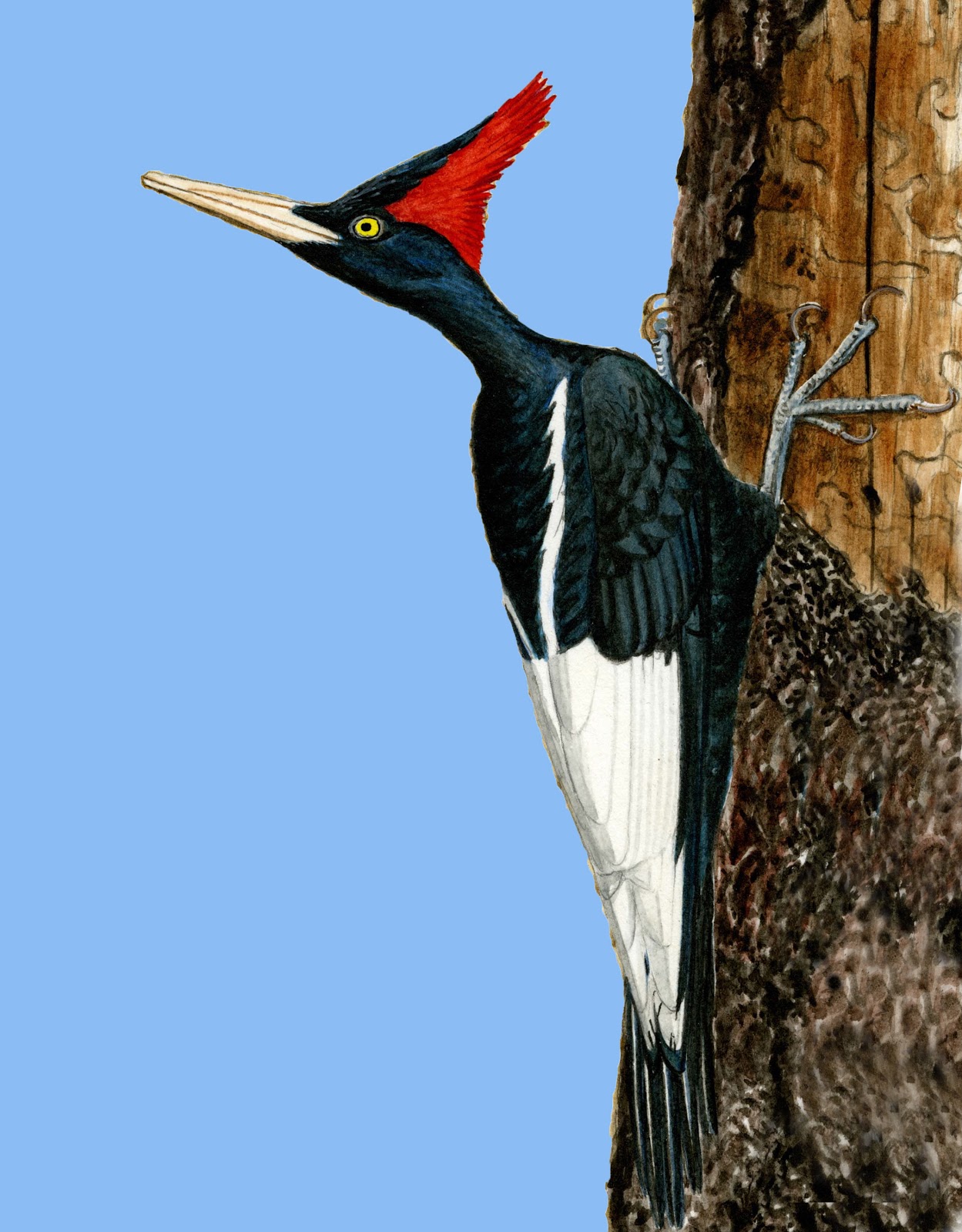
I pulled out my woodpecker illustrations
and invited him to look through them, asking him if he remembered ever seeing any
of them. The first one in the stack was the Acorn Woodpecker.
“Si, si,” he said, pointing at the
granary log on his wall and talking animatedly. “El poquito carpintero.”
He
paused for a moment when he flipped to the picture of the Lineated Woodpecker,
then shook his head. But when he looked at the Imperial Woodpecker, his face lit up. “Ah, si, si. El pitoreal. Carpintero gigante,” he
said in an excited singsong voice. He obviously knew the bird well and was
genuinely enthusiastic. Pitoreal,” he said again, holding the
illustration gleefully. “Muy bonito carpintero.” He gushed about the
bird, telling us how beautiful and amazing it was. He had often run across them
when he was younger, he said, but only in the high country, in the great mesa
pine forests.
They
were never common, he said. He sometimes went weeks without seeing any but
would then run across a group of five or six or more. They were difficult to
miss because they were so noisy, their trumpet-like calls echoing through the
forest. And they were very approachable. One time he was traveling on horseback
with another man when they came across a group of them. The man told him he had
heard that the birds have a diamond bill, and he wanted to shoot one to see if
it was true. Pulling out his saddle gun, the man shot one of the woodpeckers,
shattering its shoulder and bringing it tumbling to the ground, shrieking
loudly in distress. As the two men went to pick up the bird, the other pitoreales flew in, chattering
excitedly, just a few feet away. The man wanted to shoot more of them, but Pedro wouldn’t allow it. He could see no point in it.
I
was in shock. Not only had I found someone with an intimate knowledge of the Imperial Woodpecker, he had once even held a wounded one in his hands and
prevented some others from being shot. He was so lucid and his observations so
detailed, providing the kind of scientific data so lacking with this species.
He told me these groups of pitoreales
were usually about twenty kilometers apart, which gave me a better idea than
anything else I’ve read about their population density and how far they ranged
in their foraging. And then he told me about how he’d
watched some Imperial Woodpeckers raid the granary of some Acorn Woodpeckers.
The huge woodpeckers would pry off the bark of the tree with their massive
pearl-white bills, he said, sending acorns raining to the ground, then drop
down to eat them as the tiny Acorn Woodpeckers flew around, furiously
protesting the theft.
And
it was clear his testimony was real. These mountains are so isolated. Few
people living in the Sierra Madre have read anything about birds. All they have is their own observations. This
made it all the more clear to me how important it was to continue my
interviews. The Imperial Woodpecker was never adequately studied by science. Anything that can be found out
now, while a few of these witnesses to the Imperial Woodpecker still live, adds
vital data to our knowledge of this species. And if by some miracle these
interviews led me to a pair of the birds, still nesting in some remote corner
of the Sierra Madre, I thought, perhaps the species could yet be rescued from extinction.