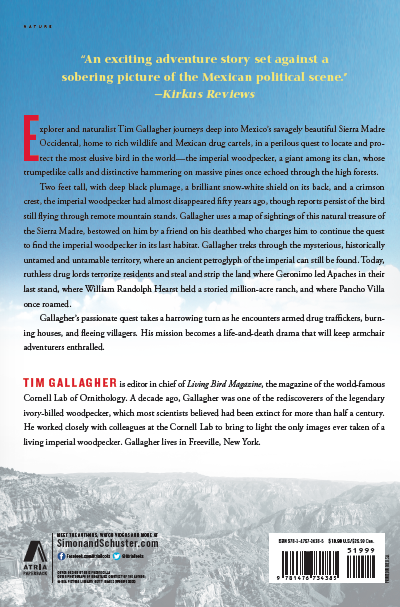
I'm pleased to announce that Simon & Schuster has just released a new paperback edition of Imperial Dreams: Tracking the Imperial Woodpecker Through the Wild Sierra Madre, about my perilous travels in the drug lands of northern Mexico in search of the world's rarest bird. The Imperial Woodpecker is a giant—the largest woodpecker that ever lived—and the closest relative of the famed Ivory-billed Woodpecker of the American South. Many believe the Imperial Woodpecker is extinct, but I set out to see if any of them might yet exist in the remotest reaches of the high-mountain mesa pine forests of Mexico.
Showing posts with label Sierra Madre Occidental. Show all posts
Thursday, January 19, 2017
Tuesday, October 8, 2013
Speaking in Texas next week
I hope all of my Texas birding friends will come to my talk about the Imperial Woodpecker next Thursday at the World Birding Center at Quinta Mazatlan in McAllen, Texas. The talk begins at 6:00 p.m. on October 17. For more information, call (956) 681-3370. A map is pasted below.
Monday, August 26, 2013
George Plimpton and the Imperial Woodpecker
(Illustration by Don Eckelberry, from the Audubon article.)
One of my favorite popular articles about the Imperial Woodpecker was written by famed author George Plimpton for the November-December 1977 issue of Audubon. Plimpton had gone searching for the bird in Mexico's Sierra Madre Occidental with his friend Victor Emanuel, the legendary birder and founder of Victor Emanuel Nature Tours. The article was titled "Un Gran Pedazo de Carne"—which literally translates "A Great Piece of Meat" and is how a man Plimpton interviewed in the Sierra Madre described an Imperial Woodpecker he had killed and eaten fourteen years earlier.
Unfortunately, Plimpton introduced some apocryphal information in this article. When he mentioned William Rhein (the man who had taken 16mm footage of a female imperial—the only photographic documentation in existence of a living Imperial Woodpecker) he misspelled his name as "Rheim." But worse, he wrote, "On Rheim's next trip into the area in 1958, he met an Indian on the trail carrying a dead imperial he had shot: that was probably one of the pair Rheim had seen in 1954. That expired bird in the Indian's hand is the last authoritative sighting [of an Imperial Woodpecker].
This information is wrong on several counts. Rhein went to Mexico not twice but three times—in 1953, '54, and '56—and never in 1958. And Rhein did not run into someone carrying a fresh-killed Imperial Woodpecker. What Plimpton may have been inaccurately reporting was something Rhein wrote in a March 1, 1962, letter to Ivory-billed Woodpecker researcher James Tanner: "In 1955 when I was unable to return to Mexico the local Indian shot the parent birds that I had localized in the previous year. When we returned in 1956 there was one lone female flying about. I obtained some poor pictures of this bird." This 1956 bird was the one that Rhein filmed and was truly the last authoritative (and only photographically documented) sighting of an Imperial Woodpecker. Plimpton repeated his error in a book review he wrote for the New York Review of Books in March 1993.
I am a great admirer of George Plimpton's writing and would not criticize him except that these errors have found their way into the scientific literature and need to be corrected. (But the Audubon article is still well worth reading.)
One of my favorite popular articles about the Imperial Woodpecker was written by famed author George Plimpton for the November-December 1977 issue of Audubon. Plimpton had gone searching for the bird in Mexico's Sierra Madre Occidental with his friend Victor Emanuel, the legendary birder and founder of Victor Emanuel Nature Tours. The article was titled "Un Gran Pedazo de Carne"—which literally translates "A Great Piece of Meat" and is how a man Plimpton interviewed in the Sierra Madre described an Imperial Woodpecker he had killed and eaten fourteen years earlier.
Unfortunately, Plimpton introduced some apocryphal information in this article. When he mentioned William Rhein (the man who had taken 16mm footage of a female imperial—the only photographic documentation in existence of a living Imperial Woodpecker) he misspelled his name as "Rheim." But worse, he wrote, "On Rheim's next trip into the area in 1958, he met an Indian on the trail carrying a dead imperial he had shot: that was probably one of the pair Rheim had seen in 1954. That expired bird in the Indian's hand is the last authoritative sighting [of an Imperial Woodpecker].
This information is wrong on several counts. Rhein went to Mexico not twice but three times—in 1953, '54, and '56—and never in 1958. And Rhein did not run into someone carrying a fresh-killed Imperial Woodpecker. What Plimpton may have been inaccurately reporting was something Rhein wrote in a March 1, 1962, letter to Ivory-billed Woodpecker researcher James Tanner: "In 1955 when I was unable to return to Mexico the local Indian shot the parent birds that I had localized in the previous year. When we returned in 1956 there was one lone female flying about. I obtained some poor pictures of this bird." This 1956 bird was the one that Rhein filmed and was truly the last authoritative (and only photographically documented) sighting of an Imperial Woodpecker. Plimpton repeated his error in a book review he wrote for the New York Review of Books in March 1993.
I am a great admirer of George Plimpton's writing and would not criticize him except that these errors have found their way into the scientific literature and need to be corrected. (But the Audubon article is still well worth reading.)
Thursday, July 25, 2013
Saturday, June 29, 2013
Of Dodos, Darwin—and Imperial Woodpeckers
Photo: Tim Gallagher/Courtesy of The Natural History Museum
I apologize for going so long without writing a new blog post. For almost three weeks, I’ve been traveling around England, visiting friends and relatives, birding, sightseeing, and exploring various museum collections. One of my most interesting days on the entire journey was spent at the Natural History Museum at Tring—about 30 miles northwest of London—where the bird collection is housed.
What’s most remarkable about this collection is the number of type specimens, or syntypes—an individual or set of specimens upon which the scientific description and name of a new species is based—housed there. I saw the first
specimen of a California Condor, collected more than two centuries ago by
Archibald Menzies as it dined on a beached whale on the Monterey Peninsula.
Menzies was surgeon during Captain George Vancouver’s epic voyage of discovery from
1791 to 1795. I marveled at the full standing skeleton of a Dodo, and I was delighted
to see the finches and other birds collected by young Charles Darwin in the
Galapagos Islands during the voyage of the Beagle.
But for me, the most special specimens were the four Imperial
Woodpeckers once owned by famed ornithologist and bird artist John Gould. (Two
more of his Imperial Woodpecker specimens reside at the Liverpool Museum.) The
scientific world first took note of this species on August 14, 1832, when Gould
brought several specimens of this previously undescribed bird, “remarkable for
its extraordinary size,” to a meeting of the Zoological Society of London,
where they must have created quite a sensation. It was Gould who gave the bird
its regal appellation—Picus imperialis—which was later changed to Campephilus imperialis. (Another 19th-century English ornithologist, George Robert
Gray, established the genus Campephilus,
which means "lover of grubs," the primary diet of these birds, the
larvae of wood-boring beetles.) What a bird. What a discovery.
(Photo by Tim Gallagher/Courtesy of The Natural History Museum)
Gould was vague about where the specimens were
collected, saying they were obtained from “that little explored district of
California which borders the territory of Mexico.” Apparently, the skins were
actually collected by an Italian mining engineer named Damiano Floresi, who
collected a number of birds early in the 19th century in the Sierra Madre near Bolaños, Jalisco—a very long way from
California.

(Photo by Tim Gallagher/Courtesy of The Natural History Museum)
Robert Prys-Jones (above, holding one of Gould's Imperials), curator of birds at the museum, was kind
enough to give me a behind-the-scenes look at the collection and let me photograph
the specimens that most interested me. It was an unforgettable morning.
Saturday, May 11, 2013
Imperial Dreams reviewed in the Wall Street Journal
The Birder’s Holy Grail
The Imperial Woodpecker—at two feet tall, the largest woodpecker that
ever lived—has not been seen in more than half a century.
By Julie Zickefoose
Even though Tim Gallagher reported seeing
an ivory-billed woodpecker, the imperial woodpecker’s northern cousin, fly across
Arkansas’s Bayou De View in 2004 (and wrote a 2006 book, “The Grail Bird,”
about his quest), you're aware from the get-go that his hunt for the imperial
woodpecker in Mexico won't be a saga of discovery. There won’t be a photo of an
oversize, pied woodpecker on the book’s cover, just an artist's rendering.
Instead, “Imperial Dreams” is more along the lines of Peter Matthiessen’s “The
Snow Leopard.” It’s yearning, put into words and wistfully unrequited.
Sheer precipices abound in northern Mexico’s
Sierra Madre, but drug dealers known as narcotraficantes have turned
this place into a foreboding nightmare landscape. It's there, in remnant
old-growth pine savanna, that Mr. Gallagher seeks his dream bird, leaving home
and family for five expeditions through one of Earth’s most dangerous mountain
ranges. This is where Geronimo surrendered to Gen. Nelson Miles in 1886; where
Pancho Villa looted William Randolph Hearst’s ranch; where the Tarahumara
Indians, those fabled light-footed, long-distance runners, clung to their
lifestyle well into the 20th century. Today it is a barely modernized place of
adobe huts and wandering burros; the explorers’ trucks jolt along two-track
roads are faster walked than driven.
Mr. Gallagher paints vivid pictures of an
impoverished populace under the thumb of the rapacious drug lords, who log
illegally to clear patches for opium and marijuana, who kill indiscriminately
and without legal consequence to maintain their duchies. In one harrowing
passage, Mr. Gallagher and his friends ride in a narcotraficante’s pickup,
having fallen into nervous collaboration with him in their quest for access to
unlogged forest. As I read, I wondered why the author was going through it all,
and wondered again and again as he rattled his teeth in old vehicles and
collapsed from dehydration and exhaustion, or dodged thieves and druglords’
spies, always chasing an ornithological phantasm.
The imperial woodpecker, like its smaller
American cousin, the ivory-billed woodpecker, is almost certainly gone. These
majestic Mexican birds were deliberately persecuted, with loggers shooting them
and even poisoning the trees upon which they fed, under the false belief that
the imperial woodpeckers damaged valuable timber. Yet the inaccessibility of
what mature pine forest remains lures Mr. Gallagher ever onward—perhaps a pair
or two still cling to life in these high cold mountains. He seeks out village
elders who remember seeing the woodpeckers, each anecdote of their encounters
throwing a little more propellant on his all-consuming fire. Finally, he must
be content not with seeing the bird for himself but simply with speaking with
those aging eyewitnesses who knew it. As his role subtly shifts from explorer
to recorder, he loosens his obsessive determination to find the bird, relegating
himself to a reporter’s role and readying himself for an eventual escape from
an underworld of fantasy and desire.
I’m glad that there are people in this
world like Tim Gallagher: people who leave their armchairs, sweat bullets at
armed roadblocks, and eat cold sardines, beans and noodles so the rest of us can
marvel at their adventures. I’m glad that Mr. Gallagher is a wonderful
storyteller and deeply knowledgeable ornithologist, who also has the nerve of a
military commando. Every time I put this book down, I picked it up again to
take in just one more chapter, lured onward by the same tantalizing bits of
evidence that kept Mr. Gallagher going. Aghast at the risks he was taking, I
was caught by the scimitar-clawed grip of the world's largest woodpecker on his—and
my—imagination.
Tuesday, April 23, 2013
Wednesday, April 17, 2013
A Pennsylvania Dentist in the Mountains of Mexico
I've always loved the story of William Rhein—the
indefatigable Imperial Woodpecker searcher who launched three self-funded
expeditions into the vast Sierra Madre of Mexico in the 1950s to try to
document these remarkable birds as they hovered even then at the edge of
extinction. I sometimes wonder why he did it. Rhein had an excellent income
from his dental practice in Harrisburg, Pennsylvania; a nice home; and no
children, so he and his wife could afford to indulge themselves in every way.
But instead he chose to drive south with a few buddies and spend up to two
months at a time, roughing it in the outback of Mexico, living on beans, booze,
and tortillas.
(Photo
by Frederick K. Hilton)
Bill Rhein
(at right, above) with his friends George and Walter Kohler in the Sierra Madre
in 1953, during the first of three expeditions in search of the Imperial
Woodpecker.
Of course, it was a great adventure. These guys
were World War II veterans, and perhaps they missed the thrills, danger, and
sense of camaraderie they'd experienced in combat. And bird study was a
lifelong obsession with Rhein. Although he did not have a degree in ornithology,
he was an ornithologist to the core—and also a gifted bird photographer and
cinematographer. Rhein's lucrative dental practice provided all the funds and
time he needed to do anything he wanted, and the Imperial Woodpecker was the
ideal species for an obsessive quest—a bird that had barely been studied and
never photographed alive. Perhaps it was the challenge of accomplishing
something that had never been done that spurred him on.
In the course of working on Imperial Dreams, I was fortunate enough
to interview two surviving members of Rhein’s expeditions—Frederick K. Hilton
(who went with him in 1953) and Dick Heintzelman (who went in 1956)—and they
filled me in on the details of the expeditions and shared their photographs
with me.
The first thing Rhein did to prepare for his expedition
was to visit famed Cornell professor Arthur A. Allen (founder of the Cornell
Lab of Ornithology), who had searched for Imperial Woodpeckers in 1946.
Allen—along with his wife Elsa and 20-year-old son David—had spent six weeks in
Mexico, driving the atrocious mountain roads in a station wagon and a sedan,
both laden to the gunwales with camera and sound-recording equipment. They
actually located one of the birds, a lone female, but were unable to photograph
it or make a sound recording. Allen was generous to Rhein, providing him with maps,
advice on where to go, and the names of people to contact in Mexico. He even
loaned Rhein a huge parabolic microphone and a wire recorder (an early
sound-recording device that recorded sound onto thin steel wire) in case he got
a chance to document the bird’s voice, which had also never been done.
Rhein and three of his friends loaded up his Chevy
panel truck with all of their gear and headed south in the late spring of 1953,
driving all the way from Harrisburg, Pennsylvania, to the city of Durango, Mexico,
some 2,500 miles away. Although they struck out in the first two areas they
explored, the men eventually found several Imperial Woodpeckers (including a
pair with two young) near Los Laureles, a tiny village in the high country of
Durango.
(Photo by
Frederick K. Hilton)
Walter Kohler looks at a fallen tree where seconds earlier three Imperial Woodpeckers had been foraging.
Some of the local people were suspicious of the
strange equipment they carried, such as the odd-looking metal parabola, which
was bigger around than a sledding disk, and the wire recorder. This was in the
early days of the nuclear age, and some of them suspected the Americans were
searching for uranium.
The sound-recording equipment proved to be
impractical for the job at hand. They brought along six truck batteries to
power the setup, which did not allow them the mobility they needed to follow an
Imperial Woodpecker closely and record its call—which is too bad; no recording
of the bird’s voice exists, and no one has ever had a better chance to record
it than Rhein and his friends. They
were also unable to take still photographs or film footage on this or their
follow-up expedition in 1954
On
his third and final expedition to Mexico in 1956, Rhein finally successfully
documented an Imperial Woodpecker, capturing a variety of behaviors on 85
seconds of 16mm Kodachrome motion-picture film. But unfortunately, the film
didn’t meet Rhein’s strict professional standards, and he kept it to himself
for decades. He had filmed the segment from the back of a mule as the
woodpecker hung around, flying from tree to tree in a circle, and occasionally
foraging.
Clips from
William Rhein’s 1956 footage of a female Imperial Woodpecker.
The world might very well never have learned about
Rhein’s Imperial Woodpecker film if not for the efforts of my colleague Martjan
Lammertink, who tracked down Rhein and interviewed him less than two years
before his death. Martjan had read a letter in the Cornell archives that Rhein
had written to woodpecker researcher James Tanner in the early 1960s, in which
he had briefly mentioned the Imperial Woodpecker footage he shot in Mexico. Martjan
was living in the Netherlands at the time, but the next time he came to
America, he tracked down Rhein at his home in Pennsylvania.
Rhein and his wife greeted Martjan warmly and invited
him inside. Later, they sat down in the living room and Rhein set up his old
16mm projector and screen and began running the film. Martjan had the foresight
to turn on a tape recorder as he sat with them as the projector rolled. Pat
Leonard at the Cornell Lab has put together some of Rhein’s best footage and
used the conversation between Rhein and his wife and Martjan as a voiceover. You
can view it here:
I love hearing the comments of Rhein and his wife.
Neither of them had viewed the film in decades. As for Martjan, he was stunned.
Although it only ran a total of 85 seconds, the film was far better than he could
ever have imagined. The bird was easily identifiable and engaged in a variety
of behaviors—flying, foraging, hitching up a tree. It holds a goldmine of information
about a species that has barely been studied. To this day, it is the only
photographic documentation ever made of an Imperial Woodpecker, and its
importance cannot be overstated.
Subscribe to:
Posts (Atom)