This is a
book about another Tim Gallagher search for a bird long unseen. It’s a story of
extreme birding—extreme in concept and in undertaking. It’s a story of a
treasure hunt in the Sierra Madre of Mexico. It has danger, bad guys, and an
old map.
You remember Tim. He’s
the fellow who with a friend reported an Ivory-billed Woodpecker in an Arkansas
swamp in 2004. Subsequently, Gallagher’s employer, the Cornell Lab of
Ornithology, brought dozens of people to Arkansas to continue the search. As
chronicled in Gallagher's The Grail Bird (Houghton
Mifflin, 2006), it was a successful effort. There were many more reports.
This new book is
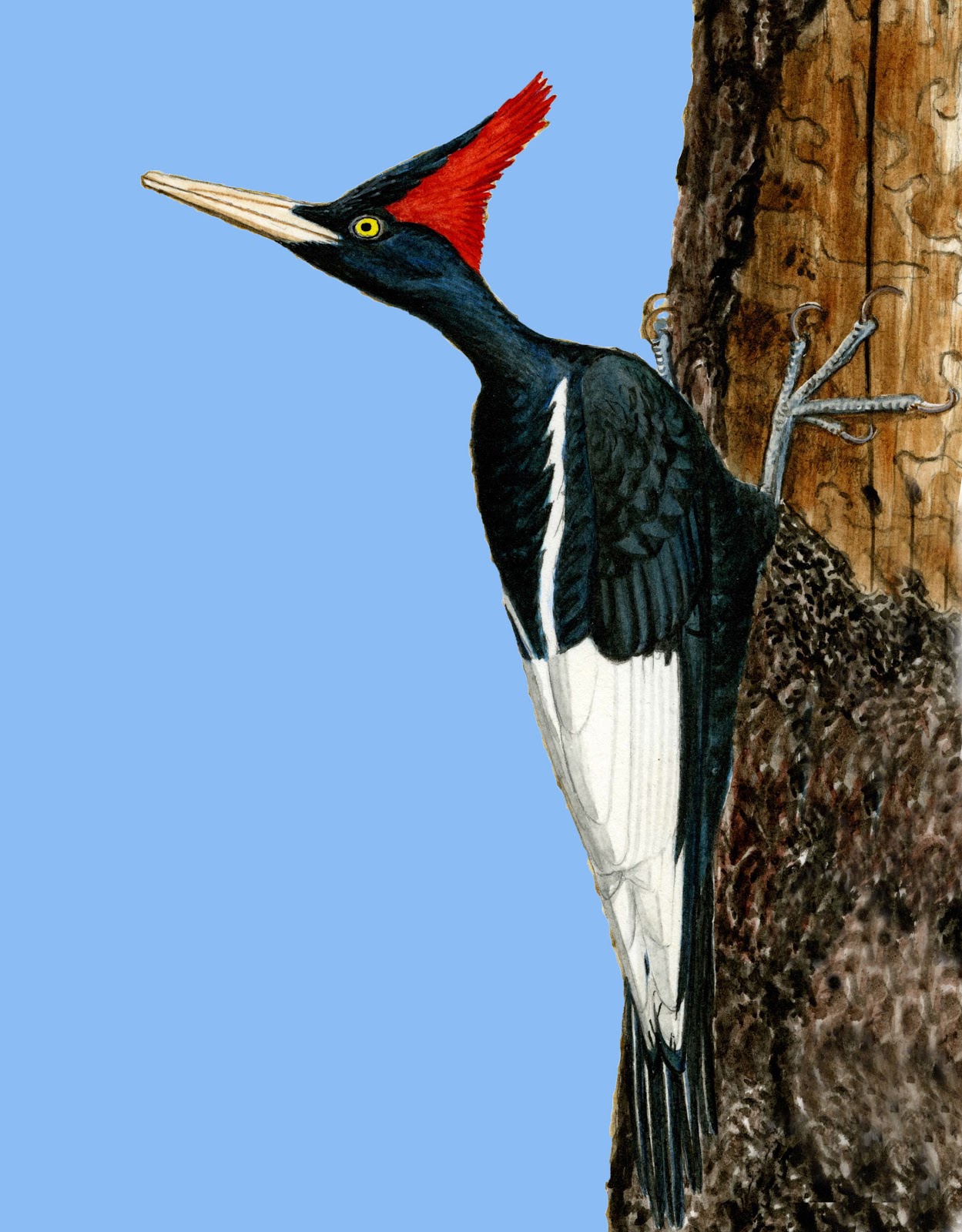
about the Imperial Woodpecker of Mexico, cousin to the Ivory-billed, but
bigger: a woodpecker two feet long from tail to the end of its chisel bill.
Let’s make this point
early: Ten words in to the book’s first sentence, Gallagher writes: “[T]here
once lived a woodpecker…” Which does not slow him down a bit.
Gallagher's Grail Bird is a fine book about the
Ivory-billed adventure. His subject then was current, in the news, a subject of
debate. His new book, Imperial Dreams: Tracking the Imperial Woodpecker
through the Wild Sierra Madre, tells a different story, a different kind of
story.
The Ivory-billed
search began on a trail six days old. Gallagher followed a tip. The Imperial
Woodpecker comes with no hot tips. Gallagher’s information on thinly possible
sightings ranges in age from six years to six decades.
Gallagher is a man of
dreams and firm beliefs, and his books, including The Grail Bird and the gripping memoir Falcon Fever (Houghton
Mifflin 2008), identify him as a man of obsessions. He is not easily
discouraged, and Imperial Dreams covers five woodpecker searches in the
Sierra Madre, most extensively his final trip in 2010.
This is an adventure
story as much as, or more than, it is a bird story. If you’ve ever hiked long
and hard in search of a bird, been wet for days, slept on the ground, eaten
poorly, you’ll relate to this tale. It is likely to exceed any memories of your
own worst trip. Gallagher many times mentions encounters with narcotraficantes. They carry AK-47
rifles; this is their land.
You will learn a good deal about the Imperial Woodpecker. The
book is a history of its habits, its habitats, and the people who have seen it.
There is mention of the other Campephilus woodpeckers of Central and
South America; our Ivory-billed was not the only child in that family.
There’s a chapter
about the Apaches and their famous chief Geronimo, who once used these
mountains as sanctuary. Consider him a good guy in this context: The danger of
running into his band of followers kept settlers and loggers out of the area
until the late 1930s. Loggers destroyed woodpecker habitat; settlers ate the
birds.
Gallagher and his
companions—most often Martjan Lammertink, the Campephilus woodpecker
expert from the Cornell Lab of Ornithology, and always a Mexican guide or two—search
out people, usually very old people, who have seen the Imperial. Residents call
the bird pitoreal. The searchers follow stories and rumors, letters, and a map
drawn by Mexican graduate students in the 1970s. The map came into the hands of
David Allen, son of Cornell's own Arthur A. Allen, who gave it to Gallagher.
The Allens had seen the woodpecker in the 1940s.
The map lacked an
X-dig-here mark. Gallagher managed to find one of the grad students, then in
his nineties. Age and a stroke had wiped his mind of woodpecker details.
None of what
Gallagher and his companions were doing was simple or easy or, often, even
safe. Deep into the 2010 trip, tight-roping his way along the rocky edge of a
deep canyon, Gallagher reaches his limit. Soaked with sweat, vision blurred,
gut knotted, heart first fluttering then pounding, he passes out and rolls off
the edge. Ten feet down, he and his backpack are stopped by a small tree, the
only thing for 50 feet fore or aft that could have kept him from splatting on
the rocks an echo below.
They were heading for
a mesa topped with old-growth pine, the disappearing habitat of the Imperial.
Logging and people with guns who shot the birds for food or sport were, or
possibly are, the survival problems. (Gallagher speculates that timber
harvesters also shot the birds to be rid of that environmental conflict.) Atop
the mesa, scanning the valley below for birds, their glasses pick up a neat
rectangle of tended crop—opium poppies. They find these often, and the
discoveries quicken their step.
I say “were or are” the problem because there is no problem
if there are no Imperial Woodpeckers. Gallagher does not see one. He doesn’t
hear one. He finds no conclusive sign. He writes of them in the past tense. But
he hopes. The Sierra Madre region where this search is centered held the birds,
and it is huge, about 90,000 square miles. Its basic inaccessibility makes
Arkansas or Louisiana swamps look like parkland. It’s like the Ivory-billed
story was for years and years: It’s hard to prove a negative.
If you want to see
the bird yourself, there is a film, made in 1956 by a dentist from
Harrisburg, Pennsylvania, named William Rhein. On the last of his four trips
into the Sierra, he shot 85 seconds of 16mm film of the bird. He kept the film
to himself because its quality did not meet his standards. It was found some
years ago thanks to Lammertink’s detective work. Eventually, it was given to
the Cornell Lab of Ornithology.
A realist, Gallagher
ends the book with hopeful comments on changes made by the Mexican government
that might improve Sierra Madre conservation and reduce the presence of drug
gangsters. He also gives this cautionary note: If you want to continue the
search yourself, "you stand a far better chance of getting killed in the
Sierra Madre now than of ever seeing a pitoreal.”
- Jim Williams
writes about birds for the Minneapolis StarTribune. He also does bird
photography and writes a birding blog for the paper. He was associate editor of
Birding from 1998 to 2003. Most of
his birding is done in his Minnesota neighborhood.
Recommended citation: