Monday, February 27, 2023

Once Upon a Time in an Arkansas Bayou

Ivory-billed Woodpecker by John Schmitt

Today marks a special anniversary for me. It was exactly nineteen years ago on February 27, 2004, that Bobby Harrison and I saw an unmistakeable Ivory-billed Woodpecker fly across the water barely 70 feet in front of our canoe and swing up to land on the trunk of a tupelo. It's a moment I'll never forget. We both yelled "Ivory-bill!" and, of course, spooked the bird, which flew a short distance to another tree and quickly hitched around to the other side of the trunk. We frantically paddled to the edge of the water, abandoned our canoe, and went off scrambling through mud and over fallen tree trunks as the huge woodpecker flew from tree to tree, tantalizingly close and yet so out of reach. Bobby had been searching for Ivory-bills for more than 30 years. He broke down and wept after our sighting, saying, "I saw an Ivory-bill...I saw an Ivory-bill..." I just stood in stunned silence. 

Until that moment, I had been somewhat agnostic about whether the Ivory-billed Woodpecker still existed. There were strong points on both sides of the argument. But regardless, I felt it was vitally important to locate people who had memories of this bird and to interview them as soon as possible. Many of the people I interviewed in the beginning were in their 90s, and I knew they wouldn't be around much longer. If the Ivory-bill truly was extinct, these people were our last connection with the species, so I reasoned that we better ask any questions we have about the bird right now. 

But in the course of my research, I found seemingly believable people who'd had much more recent sightings than that of the bird sketched by artist Don Eckelberry in Louisiana's Singer Tract in 1944. Some of them had purportedly been seen in the 1950s, '60s, and '70s by various hunters and others who knew the area and its wildlife well and seemed believable. Bobby and I started going together to check out the areas where the sightings took place. All too often, the areas had been destroyed to make way for agriculture and various other developments. But sometimes the places still looked great. The only problem was it had been so long since these sightings took place.

Then it happened. A kayaker, Gene Sparling, saw a large woodpecker in a bayou in eastern Arkansas and posted a description on a canoe club list-serv. We tracked Gene down and spoke on the phone with him just four days after his sighting. Bobby and I dropped everything and headed to Arkansas a few days later to spend a week floating the bayou with Gene. 

Bobby and I launched our canoe in the muddy brown bayou and followed Gene Sparling into a wilderness of swamp.

Bobby (left) and Gene on a chilly morning at Bayou de View on February 27, 2004. 

Tim Gallagher at Bayou de View.

Shortly after 1:00 in the afternoon—while Gene was up ahead, half a mile or so away—the bird flew across in front of us and changed our lives forever.

We went through every emotion imaginable before Gene came back and found us babbling barely coherently about the bird we'd seen. "Welcome to the Sasquatch Club," he said, and we all laughed our heads off. 

Tim and Bobby about an hour after their Ivory-bill sighting.

Left to right, Gene Sparling, Bobby Harrison, and Tim Gallagher later on the day of the sighting.

Ed Bradley interviewing Tim Gallagher and Bobby Harrison for "60 Minutes."

If you'd like to read more about our Ivory-billed Woodpecker searches in 2004 and 2005, here's a link to "The Best Kept Secret"—an article my wife, Rachel Dickinson, wrote for Audubon fourteen months after our sighting. Or you could read my book, The Grail Bird.

As many of you know, the U.S. Fish & Wildlife Service has proposed declaring the Ivory-billed Woodpecker extinct and removing it from the Endangered Species List. In response, I wrote an opinion piece for Audubon titled "Is it Really Time to Write the Ivory-billed Woodpecker's Epitaph?" At the moment, the final decision is still pending—and frankly, I strongly hope they decide against it.

Friday, February 10, 2023

Bookends: A Tale of Two Peregrine Falcon Eyries

My life has been bookended by two peregrine falcon eyries—one on a rugged, Gibraltar-like rock on the central California coast (above right); the other a continent away in a gorge with a spectacular waterfall, near where I live in Upstate New York. I'm not sure which one I should begin this essay with. The eyrie at Morro Bay was the first peregrine falcon nest I’d ever seen in person. It was in the late 1960s, while I was still in my teens. I stood there with mouth agape as an adult female came streaking across the cliff face and landed on her nest ledge. So graceful; so perfect in every way. 

But even then, the other nest—at Taughannock Gorge near Ithaca, New York—already had a strong hold over me. I'd seen a picture of the eyrie several years earlier, at the age of twelve, and it seemed to epitomize everything I admired about peregrines: the beauty of the birds; the grandeur of their domain.

In the picture at left above—taken by famed Cornell ornithologist Arthur Allen in 1926—three young peregrines lie on a nest ledge in the lower lefthand corner while their mother perches on a limb diagonally above and to the right of them as Taughannock Falls thunders down in the background. I'd first seen the picture in an old copy of A.C. Bent's 1937 classic Life Histories of North American Birds of Prey that my mother bought for me at a used bookstore. The image stood out to me even then and is still my favorite depiction of a peregrine eyrie. 

Morro Rock on the California coast. Photo by Tim Gallagher

I had no idea what a huge influence both places would have over my life. I was an English major through much of my early days in college, writing short stories, poetry, essays, a few one-act plays, and even the rough draft of a novel. But I knew a couple of journalism majors, and I always admired the way they could get a piece of writing done, no matter what distractions and time constraints they faced. If they had a deadline, they just sat down and pounded out their stories, writer's block be damned! I decided to take some journalism courses to help me develop some discipline—and it worked. Before long, I was cranking out news stories and feature articles with the best of them.

I soon joined the staff of our campus magazine at California State University: Long Beach and began searching for an interesting article topic for the next issue. This was in the 1970s, when peregrine falcon numbers had already crashed across North America and Europe as a result of DDT contamination in their environment. They were already extinct as a breeding species in the Eastern United States and were barely hanging on in the West. Researchers determined that the pesticide caused the birds to lay thin-shelled eggs, which often cracked under the weight of an incubating parent. This came as no surprise to me. The female peregrine at Morro Rock that I mentioned earlier had been found dead in her eyrie just a couple of weeks after I'd seen her. A thin-shelled egg had broken in her oviduct before she could even lay it. 


Researchers were racing to find ways to stop the falcons' decline and boost their numbers. By the mid-1970s, the peregrine falcon was already on the federal endangered species list, DDT had been banned, and ornithologist (and lifelong falconer) Tom Cade had set up a massive breeding project at Cornell University and was desperately striving to reintroduce the birds in areas where their numbers had crashed. It was a daunting task for everyone involved. 


Cornell professor and Peregrine Fund founder Tom Cade with Jim Weaver at Taughannock Gorge in 1975 when they tried unsuccessfully to reintroduce peregrines at the site. Photo by David Allen

I quickly realized this would be the perfect topic for my article—but what aspect should I cover? I’d heard about a group on the coast of central California that was working to save the peregrine falcons in the state. Led by raptor biologist and avid falconer Brian Walton, the Santa Cruz Predatory Bird Research Group (SCPBRG) was based in a rock quarry on the campus of the University of California: Santa Cruz.


Actor Mike Farrell from the popular television show M*A*S*H with Brian Walton at the Morro Rock eyrie.


I went up there—about a four-hour drive away—at my first opportunity and spent several days with the team, which then included bird-artist John Schmitt, falconer Merlyn Felton, veterinarian Jim Rausch, Russell Tucker, Ron Walker, and a handful of others. They had built a falcon facility in the rock quarry with breeding chambers and flight pens. Most of the falcons they were working with had been the personal birds of falconers who had donated them to the SCPBRG as potential breeders—just as falconers had done for the captive-breeding program at Cornell. None of them could bear the thought of the peregrine falcon vanishing from the Earth.


Bird artist John Schmitt with a juvenile peregrine falcon. Photo by Tim Gallagher


Merlyn Felton with an adult male peregrine. Photo by Tim Gallagher


They were a dedicated bunch, and it was inspiring to spend time with them. One of their most important projects was attempting to ensure the success of the nesting peregrines at Morro Rock. They would remove clutches of eggs from them, substituting dummy eggs at their nest and placing their eggs in an incubator where they were in much less danger of breaking under the weight of the adults. They would later switch the dummy eggs with live young falcons, which the adults would immediately accept and begin feeding. It was all very simple and effective. Brian Walton and his wife Cheryl played a vital role in caring for these precious eggs, practically watching them round the clock to make sure the temperature and humidity were correct in the incubator. (A couple of years later Brian, still in his twenties, was diagnosed with diabetes, and in many ways, it plagued him for the rest of his life. He eventually had to have pancreas and kidney transplants. But he never stopped working hard on behalf of birds of prey, always driving himself hard to keep the project going. He died far too young in 2007 at the age of 55. I’ll always admire him.)


Falcon researcher Brian Walton and his Gyrfalcon Beulah in the 1970s. Photo by Tim Gallagher


When I got back to college, my article practically wrote itself, and it was one of the main features in the magazine that semester. A few months later, the piece won a couple of major writing awards—a Hearst Foundation National Journalism Award and a California Intercollegiate Press Association Award for Best Nonfiction Magazine Article.  


That clinched the deal for me. I was going to be a professional writer specializing in wildlife study and environmental issues. I switched my major and graduated with a degree in magazine journalism. But before I got my first magazine job, I headed north again and joined the crew at Santa Cruz. I couldn't think of anything more important than what they were doing, trying to save the peregrine falcon. 


John Schmitt lived in a tiny travel trailer in the rock quarry, where he could keep an eye on the facility night and day. Although John was never a falconer, he had admired raptors since childhood and enjoyed taking care of the falcons. His artwork was amazing, and he completed many illustrations for the SCPBRG, The Peregrine Fund, and other groups. 


Merlyn Felton (left) and John Schmitt atop Morro Rock. Photo by Glenn Stewart


Merlyn would spend a couple of months in spring and summer camping out at Morro Rock to protect the nest from intruders. (John Schmitt would later do the same for California Condors, staying for months at a time in a tiny hut in the mountains above Santa Barbara to study and help protect the birds, often going weeks without seeing another human.) They were great people, as was Danny Verrier, another falconer who played a major role at the SCPBRG. 


At first, I lived in the back of my old International Travelall truck in the rock quarry, but then I moved in with Danny and his wife and kids, who were generous enough to let Merlyn and me live at their house. Famed falcon-hood-maker John Moran also soon came aboard to help with the project. 


With Merlyn (left) and Danny (right) in the late 1970s when we worked at the Santa Cruz Predatory Bird Research Group. Photo by Brian Walton

I’ll always look back fondly on those days at Santa Cruz, spending time with a great bunch of people, helping bring back the peregrine falcon—and taking time to practice some excellent falconry. But after just a few months there, I got a job offer from an outdoor magazine based in Southern California. I was torn. I had a long talk with Brian Walton, and he strongly encouraged me to take the job. He said I could make a far more important contribution to conservation with my writing than with the work I did at the falcon project.
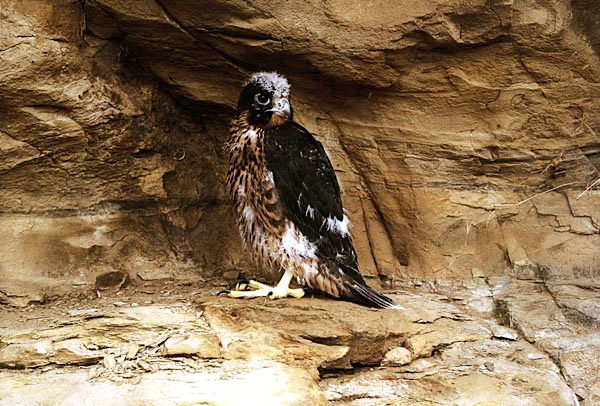

 A young peregrine falcon at its nest in California. Photo by Tim Gallagher  


It was a tough decision, and honestly, I’m still not sure I did the right thing. But I have gotten to do a lot of interesting things in my life, traveling to faraway locations—Greenland, Iceland, Alaska, Canada, Africa, the Middle East, South America—often to help with raptor studies and write about them for books and magazines.


I finally got a chance to visit the old peregrine eyrie at Taughannock Gorge in 1990. I had flown to Ithaca, New York, to be interviewed for the position as editor-in-chief of Living Bird magazine at the Cornell Lab of Ornithology—a department founded in 1915 by Arthur Allen, the very person who had taken the photograph of the eyrie that I admired so much. At the end of my interview, I asked if anyone would be willing to drive me to Taughannock Gorge, about fourteen miles away, and Scott Sutcliffe, then the Lab’s executive director, kindly volunteered. 


It was eerie to be there. As I stood at the lookout, across from the falls, I could close my eyes and just imagine what it must have been like to have the loud calls of nesting peregrines echoing up and down the gorge. Maybe someday the birds will return, I thought, wistfully. 


Taughannock Falls in spring. Photo by Tim Gallagher

The Winter 2015 issue of Living Bird—celebrating the Cornell Lab's centennial—featured an adult peregrine falcon on the cover. Photo by Cliff Beittel

I got the job at Living Bird and worked at the Lab for more than a quarter of a century, in the meantime marrying Rachel Dickinson, a writer and Ithaca native, and raising our children with her. But it wasn’t until the spring of 2020, when the COVID pandemic kicked into high gear, that peregrine falcons finally took up residence once more at Taughannock Gorge, for the first time since 1946. And I was there to watch and document their nesting. They succeeded spectacularly, raising three young. I wrote a long feature article for Audubon about it titled “Peregrine Falcons Finally Return to Nest at Their Most Famous U.S. Eyrie.” And amazingly, the article won a national award for Best Conservation Article from the Outdoor Writers Association of America. Talk about bookends. I had written two articles, 40-plus years apart—one focused on the Morro Rock peregrines and the efforts of the SCPBRG to keep them breeding successfully; the other about the Taughannock Gorge peregrines returning after a 74-year absence—and both won major national writing awards. 


Four young peregrines at the Taughannock Gorge eyrie in 2021. Photo by Tim Gallagher


I have no idea what to do for an encore, but I was happy to be invited in 2021 to take part in interviews for a documentary titled Game Hawker, about falconer Shawn Hayes, produced by Patagonia Films and directed by Josh Izenberg and Brett Marty. (I later wrote a piece for Audubon, "The Inspiring Ascent of Master Falconer Shawn Hayes.") I was flown to San Francisco and, together with Shawn and the film crew, we drove to Morro Bay to visit my other favorite peregrine eyrie. Not only was the original eyrie occupied but we saw another peregrine eyrie on a different cliff face at Morro Rock. Then, amazingly, we found out a day later that there was also a third eyrie on the seaward side of the rock that we couldn’t see. What a spectacular comeback the peregrines have made in California—and across North America. 


Falconer Shawn Hayes observing one of the peregrine falcon eyries at Morro Rock. Photo by Tim Gallagher


As I write this essay, it is midwinter and I just got home from Taughannock Gorge, about twenty miles away. I didn’t see any peregrines today, just spectacular scenery. But it looks like the falcons are here to stay. They fledged three young in 2020, four in 2021, and another four in 2022. I'm hoping that the New York State Department of Environmental Conservation will soon remove the peregrine falcon from the state endangered species list, as so many other states have done. The birds are far more numerous now than they were even before the DDT era. Perhaps someday falconers in New York State will be able to fly wild peregrines again. (At the moment, we can’t even own wild peregrines legally obtained in other states.) For now, it’s just another pipe dream—like the one I had for years that peregrines would once again nest at Taughannock Gorge. We’ll see. 


With daughters Clara (left) and Gwen at Taughannock Falls. Photo by Rachel Dickinson


Monday, March 22, 2021

The Return of "Extinct" Species

 A film crew from "CBS Sunday Morning" and reporter Conor Knighton came along with Bobby Harrison and me last year on one of our searches for Ivory-billed Woodpeckers in an Arkansas Bayou, just before the COVID lockdown. The program aired on March 21, 2021. Here are some photos (below) and a link to the show.

Jane Pauley introduced the show.

Bobby Harrison (left) with Conor Knighton and Tim Gallagher.

Tim Gallagher with the field sketches he and Bobby drew right after their sighting in 2004.

Tim and Bobby on the day of their Ivory-billed Woodpecker sighting, February 27, 2004.

Bobby Harrison and Conor Knighton.


Sunday, December 29, 2019

Remembering Steve Earle (1951-2019)


It’s always hard to bid farewell to good friends, and the past year and a half has been especially difficult with the death of so many people who were important to me—Peregrine Fund founder Tom Cade; Bird Watcher’s Digest editor Bill Thompson; and legendary falconers Bob Winslow, Bob Martin, and Mike Connolly, who I had admired since I was a young falconer growing up in California. But the death of Steve Earle, one of my oldest friends, has hit me particularly hard. He passed away of natural causes in the early morning hours on Christmas Eve.

Steve and I first met when we were just thirteen or fourteen years old, and we cut our falconry teeth together, hunting a variety of game with Kestrels, Red-tailed Hawks, Cooper’s Hawks—and later Prairie Falcons and Peregrines—at a time when the Southern California coast still had lots of wide-open spaces to fly raptors.

Thirteen-year-old Steve with a Red-tailed Hawk

Steve in his teens training a Cooper's Hawk in his Seal Beach backyard.

In addition to raptors, the ocean was always an important part of Steve’s life, as a surfer, fisherman, and beachcomber. He grew up in Seal Beach in the Sixties, the son of a schoolteacher and a commercial fisherman—a career Steve and his two brothers also took up. I worked with him for a time in the 1970s on a swordfish boat called the Volare, an Italian verb meaning “to fly”—a perfect name for a boat captained by Steve. He had recruited me because of my skills as a birder, hoping I could sit in the crow’s nest, peering at the horizon through 10x binoculars for hours at a time, searching for the telltale shape of swordfish fins on the horizon. It was a challenge, but thanks to Steve’s tutelage, I could soon distinguish between the fins of distant swordfish, striped marlin, blue sharks, hammerhead sharks, and many other species.

The Volare tied up at Fish Harbor with its swordfish plank raised.


It was a good life. We’d anchor each night off one of the Channel Islands—Santa Cruz, San Clemente, or Santa Catalina—and often catch lobster, abalone, or fish to eat in the evening. By day, we’d scour the seas, endlessly searching for swordfish basking in the sun after their morning meals. If we spotted one, we’d lower the long metal plank on the bow of the boat and one of us would walk to the end of it while the other carefully moved the boat forward, trying to get close enough to throw a harpoon at the fish. 


A finning swordfish.


                              Steve stands at the end of the plank, about to harpoon a swordfish.

It was exciting and interesting. Steve worked hard and eventually bought the Volare from the man who employed us, and he lived on the boat for many years—right up until the hull was destroyed by wood rot a few years ago. 

Steve Earle looking like the Ancient Mariner after several decades at sea in pursuit of swordfish.

Looking back on Steve's life, what I think impressed me most about him was the way he dealt with adversity—and he faced a lot of it in his later life. About a decade ago he was diagnosed with bladder cancer and went through a harrowing, hours-long surgery, which nearly killed him, and left him barely able to walk for months. I was living in Upstate New York, but I came to California and visited him not long after his surgery. He was living alone on the Volare, which was tied to the wharf in Fish Harbor, near San Pedro. It was awful, and he obviously was in a lot of pain, but he never complained. He had the most amazingly upbeat attitude, and it really got him through it. Most people would have given up, but he lived another ten years. And it wasn't a bad life. He did the things that interested him most. And he always helped his friends, talking for hours on the phone whenever one of us was in crisis. I'll always be grateful for the emotional support he gave me after the death of one of my children, when I was overcome with despair and didn't see how I could go on. 

Shortly after his surgery, Steve holds up a picture of him at age 19 with his tiercel Prairie Falcon.

Steve didn’t fly falcons in his later years. But he never stopped loving them and spent countless hours watching nesting Peregrine Falcons on the sea cliffs and bridges and buildings of California and later on the Oregon coast, where he spent the final years of his life. 

The last time I saw Steve was just a couple of months ago in the Florida Keys, where he and I and our mutual friend, Hollis Roberts, had gone to watch the fall migration of Peregrine Falcons en route from their Arctic breeding grounds to their wintering areas in Latin America. It was Steve who originally introduced me to Hollis, when we were in our mid-teens, and the three of us always flew hawks together growing up. It was a great reunion. We saw more peregrines than any of us had ever seen in a single day. The hawk watch at Curry Hammock recorded more than five hundred peregrines one of the days we were there. We got to see many peregrines there as well as at Key West and another place where the falcons were flying right over our heads. One day when it was raining we went driving around to see if we could locate any perched peregrines, and we wildly exceeded our expectations, finding seventeen peregrines sitting on a single radio tower. We had the best time, laughing, joking, talking endlessly—and watching peregrines. We were like kids again. What could be better? 

So fair winds and following seas, my old friend, wherever you may travel. 

Migrating Peregrines in the Florida Keys.


With Steve (left) and Hollis (right) at the Florida Keys HawkWatch.

Saturday, July 20, 2019

Moonwalker


Apollo 11 astronaut Buzz Aldrin at the Sea of Tranquility. Photo by Neil Armstrong
Fifty years ago today, Neil Armstrong and Buzz Aldrin made history as the first humans to set foot on the moon. It was one of those pivotal moments—the kind of earth-shaking event about which people ask for decades after: "Where were you when...?" Fill in the blank.

I've often tried to skirt around my answer when someone asked me about the moon landing. You see, I was eighteen and a few months earlier had been convicted of possessing a small amount of marijuana—at a time when this was considered a serious crime and well worth destroying someone's life over. (Now recreational marijuana possession and use is perfectly legal in California.) I'd never previously been arrested for anything, and yet here I was, serving a 5-month sentence in a maximum-security county jail facility. I was in a classic cell-block with two tiers of cells—P Tank above and O Tank below—with a bullet-proof-glass-enclosed catwalk where the guards would randomly walk past, at any hour of day or night. The prisoners in P Tank were usually in transit to other places. They'd stay a few days then get transferred to a branch jail or to the honor farm. In O Tank, we were more permanent. The county jail authorities didn't like to send druggies to the farm or to let them participate in any kind of work-release program. In O Tank, the days went slowly. We didn't have television or even playing cards to entertain ourselves.

But a few weeks after I began my sentence, a curious thing happened. The guards gathered all the inmates from O Tank, marched us upstairs, and we crammed into the cells of P Tank, where the prisoners had a television in every cell. Together we watched Neil Armstrong and Buzz Aldrin land the first spacecraft on the moon. I've never heard of anything like that happening before or since at a jail. I suppose someone made a decision that this was too historic an occasion not to share with us, and for that I'm grateful.

Many years later  I was at an Explorers Club banquet in New York City, receiving a conservation award, when I met Buzz Aldrin. We had a nice conversation, but I never told him I'd been watching the moon walk from a jail cell on that historic day, half a century ago. I wrote about these and other experiences in my memoir, Falcon Fever (Houghton Mifflin Harcourt, 2008).

With Apollo 11 astronaut Buzz Aldrin (right), the second man to walk on the moon; astronaut Kathryn Sullivan (left), the first American woman to walk in space; and famed marine biologist Sylvia Earle at the Explorers Club Awards Banquet, New York City. Photo by Bobby Harrison


Remembering Mike Connolly


I was saddened hear that my old friend Mike Connolly passed away last Sunday. Mike began training hawks in the 1960s in the San Diego area and quickly excelled as a game hawker—first hunting cottontails and other game with his great Cooper's Hawk, Shadow, and later flying Peregrines (most notably Orchid and Witch) at ducks for years. He became a legendary figure in California falconry, and deservedly so. He was always generous with his time. He brought his peregrines to every California Hawking Club field meet for years and always let everyone tag along to watch his falcons catch ducks. He had very high standards and inspired a generation of young falconers to follow in his footsteps. I spoke with him on the phone just a couple of weeks ago when his hospice care began. I still thought he might bounce back one more time. Mike was such a powerful presence, it's difficult to accept the fact that he's gone. He will be greatly missed.

                                                                 Mike Connolly with his peregrine falcon, Orchid.                                                  Photo by Omar White

                               
Mike Connolly (left) and Scott Francis (right) came to see me when I gave a talk in Missoula, Montana, during my book tour for Falcon Fever. They were two great California falconers who are now both gone. Rest in Peace, my old friends. 


Wednesday, February 20, 2019

Fielding Lewis and the Ivory-billed Woodpecker


                   Fielding Lewis's controversial 1971 photo of an Ivory-billed Woodpecker. 

One mystery I always hoped to sort out was the identity of a hunter who had taken two snapshots of a male ivory-bill in 1971 and sent them to George Lowery, a famed ornithologist at Louisiana State University. When the man had initially reported seeing a pair of ivory-bills, Lowery assumed he had seen pileated woodpeckers and encouraged him to try to get a picture. When he subsequently shot some pictures, Lowery was convinced and went immediately to the Atchafalaya Swamp of southern Louisiana, where the man had seen the birds. Although Lowery never saw the ivory-bills, he did see an excavation the birds had started in a tree.

The man asked that his identity and the exact location of the place he’d taken the pictures not be revealed. Like many southerners, he had a visceral fear that the feds would come in and impound the land, so he couldn't hunt there anymore. Lowery respected his wishes and never divulged the information.

That summer, Lowery took the pictures to the annual meeting of the American Ornithologists’ Union, expecting all the scientists to be excited by this amazing physical proof of the continued existence of this species, even at that early date long thought extinct. Instead, he was met with immediate withering skepticism. One of the first things the other ornithologists did was to peer at the snapshots through an electron microscope. Their verdict: obviously a fraud—a taxidermied bird hung in two different trees. Some of them laughed at Lowery behind his back, jeering at his gullibility. Some darkly suggested he may have been in on the hoax. But no one who knew him could ever have believed that.

Lowery kept quiet about the affair after that, and a few years later he passed away. The story of the hunter who gave him the pictures grew from that point on until he became a legendary figure, shrouded in mystery—an old Choctaw living far out in the swamp; a greasy-haired hermit who only came to town once or twice a year to sell his beaver pelts. People speculated wildly in books and magazine articles about who he might be and where in the vast Atchafalaya Swamp he saw the birds. I had no idea who he was. I just knew that I wanted to talk with him, to look him in the eye and decide for myself whether I believed his story.

I did hear about a man named Fielding Lewis who supposedly had seen ivory-bills somewhere in the Atchafalaya in the 1970s. I wondered if there was any possibility that he could be the mystery man. One day I did an Internet search for his name and got only one hit in the entire state of Louisiana. And this Fielding Lewis did live in the southern Atchafalaya. Could it really be this easy? As I was getting ready to call him on my cell phone, I got the wicked thought: maybe I should pretend that I know he took the pictures and see what he says.

“This is Tim Gallagher from Cornell University,” I said as the man answered the phone. I’m interviewing people who have seen ivory-billed woodpeckers, and I’d like to ask you about the pictures you gave to George Lowery in 1971.”

Without a pause he said, “Okay.” Then he told me he lived out in the woods and I’d never be able to find his place. He suggested that Bobby Harrison and I meet him in front of a Cajun restaurant not far from his home. When I called my wife and told her this, she said: “Don’t do it! It’s the South. We’ll never hear from you again.” I assured her everything would be fine. Bobby is with me. What could go wrong? But to be honest, it did seem a little strange.

We ended up getting to the restaurant a couple of hours earlier than we’d planned, so I called Lewis again. A woman answered and told me he wasn’t home; he had gone to his office. His office? All my fantasies about this guy immediately imploded—the stringy-haired swamp rat living in a shack perched precariously on wobbly stilts above the swamp; the trapper poling along in his hand-hewn pirogue—all gone. And I missed that image. So who was this guy? What would he really be like?

By this time, Bobby and I were too excited to go inside the restaurant. We hung around outside, peering at every car that passed. Finally a big white Chrysler New Yorker pulled into the parking lot, driven by a portly man in his seventies, puffing on the biggest cigar I’ve ever seen.

“Fielding Lewis?” I said as he stepped outside. He nodded and we shook hands. He looked like a character from Tennessee Williams—like Big Daddy, larger than life, with a booming voice and a bone-crushing handshake.

As we drove behind, following him to his office, I noticed the frame around his license plate said “Louisiana State Boxing Commission.” I asked him about this as he opened his office door, and he told us he was the state commissioner of boxing and had been a boxer himself years earlier. Stepping into his office, we were hit by a wall of choking cigar smoke. It was like going through a time warp, passing into the 1940s. On the wall hung a black-and-white World War II era cigarette ad of a Hollywood starlet puffing a Chesterfield. Framed pictures of boxers stood on every available desk or table, including a nice autographed shot of Mohammad Ali as a teenager, when he was still called Cassius Clay.

Lewis was a great storyteller and he regaled us with endless anecdotes about his many exploits over the years and the numerous fascinating characters he’d encountered in his life. We finally got him talking about ivory-bills. He spoke about George Lowery—how he was the nicest person he’d ever met. They had become close friends, he said, and he had a picture of him posing with his grandkids. Then I hit him with the big question: “Did you know that those pictures you took caused a huge controversy with ornithologists and that some of them think the bird was taxidermied?”

He stared at me, visually stunned for moment, and then bellowed with laughter. “Now where the hell would I get a stuffed ivory-bill?”

Bobby and I came away believing his story. And when we visited the spot where he had reportedly seen the birds, we found numerous huge cypresses, but most of them were dead—victims of salt-water incursion back around the time he had seen the birds, which was interesting. Slowly dying trees like that would have been a natural magnet for infestation by wood-boring beetles and species that feed on their larvae, such as ivory-billed woodpeckers.

[excerpted from The Grail Bird by Tim Gallagher, Houghton Mifflin Harcourt]